Redundant Design Philosophy: Building Damage-Tolerant Angle Steel Towers
Quick Answer
Redundant design in angle steel towers is the engineering philosophy of incorporating multiple load paths and secondary structural members so that the failure of any single component does not lead to catastrophic collapse. In a properly designed lattice tower, if a primary leg or diagonal brace is damaged or removed, the surrounding structure redistributes the load through alternative paths, maintaining overall stability.
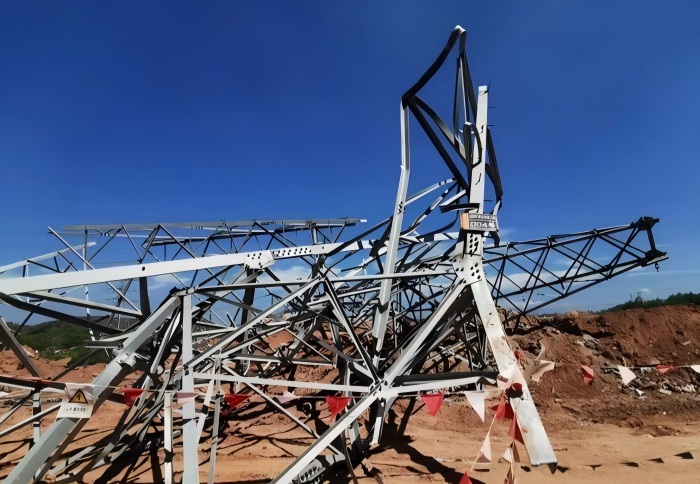
This "partial failure, overall stability" characteristic transforms a brittle structure into a damage-tolerant one. While transmission towers are often described as structures "where redundancy is minimal: the loss of a single diagonal member often triggers progressive collapse", deliberate redundant design—through secondary bracing, multiple bolt connections, and robust joint detailing—can create the alternative load paths needed to prevent disproportionate failure. This philosophy is not about adding excess steel; it is about engineering intelligence—ensuring that when the unexpected happens, the tower bends but does not break.
Key Takeaways
Redundancy creates survivability: A tower with multiple load paths can survive the loss of individual members through force redistribution
Secondary members are not optional: Redundant bracing provides intermediate support points that prevent primary member buckling and extend structural life
Joint detailing is critical: The failure of a single connection can compromise the effectiveness of an entire redundant system—as demonstrated by the 2018 KOZK tower collapse
4-legged towers offer superior redundancy: Compared to 3-legged designs, 4-legged lattice towers provide multi-path load distribution and significantly higher failure redundancy
Redundancy must be designed, not assumed: Simply adding members without proper load path analysis can create "redundant induced failures"
Trial assembly validates redundancy: Factory pre-assembly verifies that redundant systems function as intended before field erection
1. What Is Redundant Design in Angle Steel Towers?
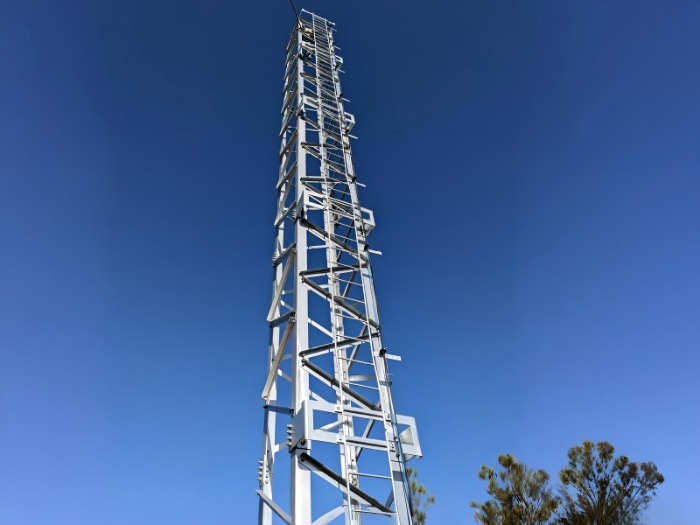
A lattice tower is a highly indeterminate spatial truss structure—meaning it has more members and connections than the minimum required for static stability. This inherent redundancy is both a blessing and a curse. When properly engineered, it provides alternative load paths that prevent collapse. When poorly detailed, it can create misleading assumptions about structural capacity.
The space truss structure endows towers with "exceptional adaptability and redundancy. Even if a member is damaged in extreme circumstances, the entire structure can maintain overall stability through force redistribution, preventing catastrophic collapse". This characteristic of "partial failure, overall stability" is the core promise of redundant design.
However, transmission towers are often described as "a rare structure where redundancy is minimal: the loss of a single diagonal member often triggers progressive collapse". This apparent contradiction resolves when we understand that redundancy must be deliberately engineered—it is not an automatic property of lattice construction.
2. The Mechanism: How Redundancy Prevents Collapse
Primary vs. Secondary Members
In lattice tower design, members are classified by their structural role:
| Member Type | Function | Example |
|---|---|---|
| Primary members | Carry the main structural loads | Main legs, primary diagonals |
| Secondary members (redundants) | Provide intermediate bracing, prevent buckling, distribute loads | Horizontal redundants, secondary bracings |
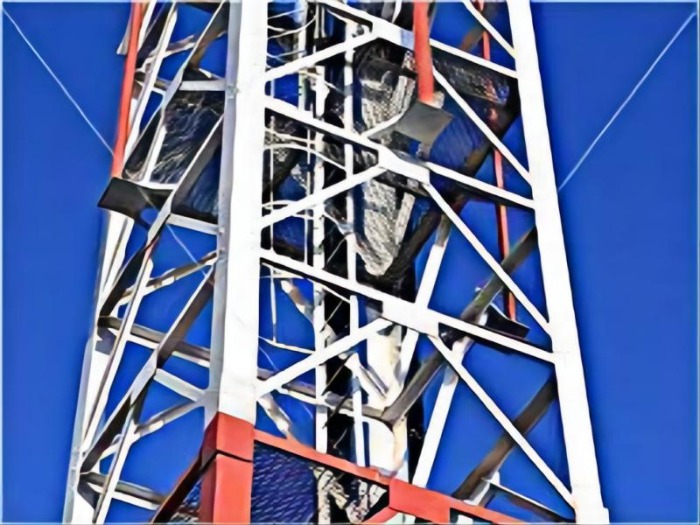
Secondary members "provide intermediate bracing points to the primary members". Their function is not to carry primary loads but to reduce the effective unbraced length of compression members, significantly increasing their load capacity.
The Unbraced Length Effect
When a redundant member is removed or compromised, the unbraced length of the adjacent primary member effectively doubles. This reduction in compressive capacity can be catastrophic. The 2018 collapse of the KOZK television tower provides a tragic illustration: "The compromised redundant effectively doubled the unbraced length of the tower leg which reduced the compressive capacity of the tower leg".
Alternative Load Paths
When a primary member fails, the structure must have alternative paths for load transfer. "The existence of alternative load paths for the transfer of excess load caused by the removal of the member is of particular importance". The alternative load path method is one of the common regulatory approaches in progressive collapse analysis.
In a well-designed redundant tower, if a diagonal brace is damaged:
1. The load it was carrying is redistributed to adjacent members
2. These members, designed with reserve capacity, accept the additional load
3. The structure remains stable, albeit with reduced safety margin
4. The damage can be detected and repaired during routine inspection
3. 3-Legged vs. 4-Legged Towers: A Redundancy Comparison
The choice between 3-legged and 4-legged lattice towers has significant implications for structural redundancy:
| Parameter | 3-Legged Tower | 4-Legged Tower |
|---|---|---|
| Structural redundancy | Lower—single-point failure more critical | Higher—multi-path load distribution |
| Torsional rigidity | Moderate | 40% higher resistance |
| Load path alternatives | Limited | Multiple—redundant paths available |
| Failure tolerance | Critical—loss of one leg can be catastrophic | Robust—load redistributes across remaining legs |
| Material efficiency | 15–30% less steel | More steel, higher redundancy |
| Best for | Cost-sensitive, lower-height applications | Critical infrastructure, high-wind zones, multi-operator sites |
The 4-legged advantage: The rectangular or square base of a 4-legged tower creates multiple load paths that a triangular base cannot provide. If one leg is compromised, the remaining three legs can redistribute the load through the bracing system—a capacity that is structurally impossible in a 3-legged design where the loss of a single leg fundamentally destabilizes the triangular geometry.
4. Critical Joint Detailing: Where Redundancy Lives or Dies
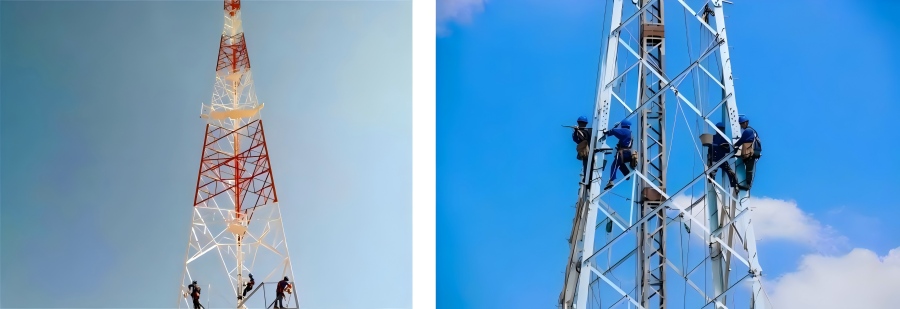
The effectiveness of a redundant system depends critically on joint detailing. Poorly designed connections can negate the benefits of redundant members—or worse, create failure mechanisms that would not exist in simpler designs.
The KOZK Tower Failure: A Cautionary Tale
The 2018 collapse of the 2,000-foot KOZK television tower in Springfield, Missouri, which resulted in a fatality and a $3.2 million settlement, demonstrates the catastrophic consequences of improper redundant member detailing:
"TCI's suggested diagonal replacement procedure was flawed in that it compromised the effectiveness of the integrated surrounding braces and the load bearing capacity of the tower legs. A single diagonal brace could not be removed without affecting the integrity of the redundant brace because the braces share two common bolts at the diagonal/redundant connection."
The root cause was specific and technical: "The cause of the communication tower collapse was the weakening of the compressive strength of the tower legs by removing the bolts at the connection of the diagonals to the horizontal redundant". The compromised redundant "effectively doubled the unbraced length of the tower leg which reduced the compressive capacity of the tower leg".
Design Recommendations from Failure Analysis
Studies of redundant-induced failures have produced specific design recommendations:
· Double bolt connections for redundant members
· Proper joint detailing to account for framing eccentricities and force distribution
· Redundant member force checks: The force in redundant members should be verified to ensure it is within acceptable limits relative to primary member forces
· Temporary bracing during maintenance: Any procedure that removes a redundant member must include provision for temporary bracing
5. Engineering Standards and Redundancy Requirements
Several standards govern redundant design in lattice towers:
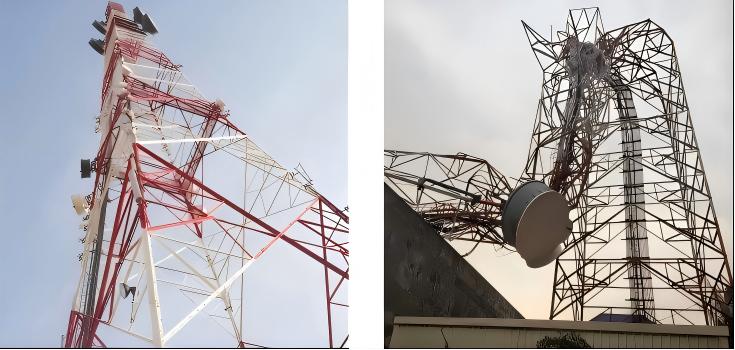
ASCE/SEI 10-15 (Design of Latticed Steel Transmission Structures) specifies design criteria for members, connections, and guys to resist design-factored loads. It includes specific sections on redundant members.
GB/T 2694 (Chinese standard for transmission tower manufacturing) establishes quality requirements that indirectly support redundancy through rigorous fabrication tolerances.
Reliability-based design (RBD) approaches are increasingly used to balance safety, redundancy, and cost-effectiveness. RBD considers the probability of failure and reliability index (β) to establish performance-based targets.
Towers being redundant, dominant failure modes must be identified using the load factor method, and system reliabilities must be evaluated at the limit state of strength.
6. Practical Implementation: Designing for Redundancy
Structural Configuration Choices
| Design Decision | Impact on Redundancy |
|---|---|
| 4-leg vs. 3-leg | 4-leg provides superior redundancy and torsional rigidity |
| K-bracing vs. X-bracing | X-bracing offers more alternative load paths |
| Double-bolted connections | Prevents single-bolt failure from compromising redundancy |
| Continuous redundant members | Provides unbroken load paths vs. segmented members |
| Hot-dip galvanizing | Preserves member capacity over decades, maintaining redundancy |
Joint Detailing Best Practices
Based on failure analysis and industry standards:
· Do not share single bolts between primary and redundant members: The KOZK failure occurred because the diagonal and redundant braces "share two common bolts". Redundant members should have independent connection points.
· Provide temporary bracing during maintenance: Any procedure that removes a redundant member must include engineered temporary bracing to maintain the unbraced length of primary members.
· Verify redundant member forces: Redundant member forces should be checked to ensure they do not exceed 2.5% of the axial force in the primary member.
· Consider eccentricities: Framing eccentricities in bolted connections affect force distribution and must be accounted for in design.
7. Case Study: Qingdao Altai Tower Redundant Design Approach
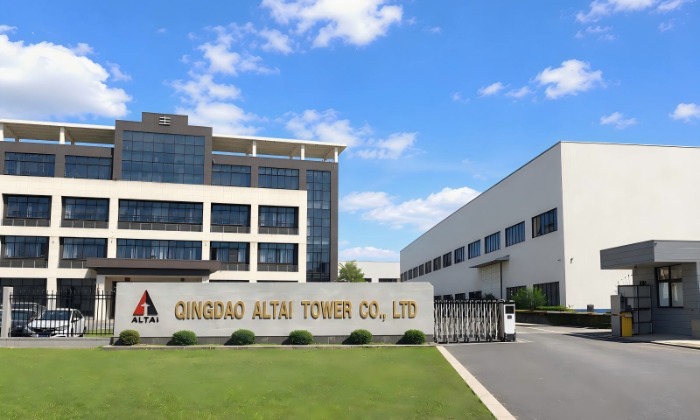
Qingdao Altai Tower Co., Ltd. is a professional manufacturer of telecommunication towers, power towers, and tower accessories, established in 2003. The company specializes in the design, manufacturing, and installation of steel towers, with products exported to more than 100 countries and regions.
Manufacturing Capabilities Supporting Redundancy
| Capability | How It Supports Redundancy |
|---|---|
| Full-process PLC-controlled production line | Ensures consistent member quality—critical for predictable redundant behavior |
| CNC punching and drilling | ±0.5 mm hole position accuracy ensures proper fit of redundant connections |
| Hot-dip galvanizing per ASTM A123 | Protects redundant members from corrosion, maintaining their capacity over decades |
| Trial assembly | Verifies that redundant systems function as intended before field erection |
| High-strength steel (Q345B/A572 Gr50) | Provides reserve capacity for load redistribution |
Design Philosophy
Qingdao Altai Tower's approach to redundant design emphasizes:
Multi-path load distribution: 4-legged configurations provide inherent redundancy
Precision connections: Accurate hole placement ensures redundant members perform as designed
Complete corrosion protection: Galvanizing preserves redundant member capacity over the tower's service life
Modular design: Enables efficient packaging and rapid deployment while maintaining structural integrity
8. Redundancy Comparison: Design Approaches
| Design Approach | Redundancy Level | Key Characteristics | Best For |
|---|---|---|---|
| Minimal redundancy (basic design) | Low | Fewer members, simpler connections, lower cost | Low-height, non-critical applications |
| Standard redundancy | Moderate | Secondary bracing, basic redundant members | Typical telecom and transmission towers |
| High redundancy | High | Multiple redundant systems, double-bolted connections, 4-leg configuration | Critical infrastructure, high-wind zones, military applications |
| Damage-tolerant design | Very high | Designed specifically to survive member loss, with verified alternative load paths | Mission-critical sites, seismic zones |
F A Q s
Q1: What is redundant design in tower engineering?
- A: Redundant design is the practice of incorporating multiple load paths and secondary structural members so that the failure of any single component does not lead to catastrophic collapse. If one member fails, the load redistributes through alternative paths, maintaining overall stability.
Q2: Why is redundancy important in angle steel towers?
- A: Angle steel towers are assembled from hundreds of bolted connections. Without redundancy, the loss of a single critical member—such as a diagonal brace—can trigger progressive collapse. Redundancy provides a safety margin against unexpected damage, corrosion, or maintenance errors.
Q3: What is the difference between a primary member and a redundant member?
- A: Primary members (main legs, primary diagonals) carry the main structural loads. Redundant members (secondary bracings, horizontal redundants) provide intermediate bracing points that prevent primary member buckling and distribute loads.
Q4: What happened in the KOZK tower collapse?
- A: In 2018, the 2,000-foot KOZK television tower collapsed during maintenance, resulting in a fatality and a $3.2 million settlement. The cause was improper removal of a redundant member, which doubled the unbraced length of the tower leg and reduced its compressive capacity.
Q5: Is a 4-legged tower more redundant than a 3-legged tower?
- A: Yes. A 4-legged tower provides multi-path load distribution and significantly higher failure redundancy. If one leg is compromised, the remaining three can redistribute the load—a capacity that is structurally impossible in a 3-legged design.
Q6: How does joint detailing affect redundancy?
- A: Poorly designed connections can negate the benefits of redundant members. The KOZK failure occurred because the diagonal and redundant braces shared common bolts. Proper detailing—such as independent connection points and double-bolted connections—is essential for redundancy to function as intended.
Q7: What is the alternative load path method?
- A: The alternative load path method is a progressive collapse analysis technique that evaluates whether a structure can redistribute loads after a member is removed. It is used to verify that redundant systems will function as intended in a damage scenario.
Q8: Can redundancy be added to existing towers?
- A: Yes. Existing towers can be retrofitted with additional bracing, redundant members, or strengthened connections. However, this requires careful engineering analysis to ensure that the new members integrate properly with the existing load paths.
Q9: What design standards address redundant design?
- A: ASCE/SEI 10-15 includes specific sections on redundant members. GB/T 2694 establishes manufacturing requirements. Reliability-based design (RBD) approaches balance safety, redundancy, and cost-effectiveness.
Q10: How does Qingdao Altai Tower ensure redundancy in its designs?
- A: Qingdao Altai Tower employs 4-legged configurations for critical applications, uses precision CNC fabrication for accurate connections, performs trial assembly to verify redundant systems, and applies hot-dip galvanizing to preserve member capacity over decades.
Conclusion
Redundant design is not about adding excess steel—it is about engineering intelligence. A properly designed redundant tower can survive the loss of individual members through force redistribution, maintaining "partial failure, overall stability". The alternative load path method ensures that when the unexpected happens, the structure bends but does not break.
The lessons from failures like the KOZK tower collapse are clear: redundancy must be designed, not assumed. Proper joint detailing, independent connection points, and double-bolted connections are not optional details—they are the difference between a tower that survives damage and one that collapses.
For project owners and engineers, the choice is clear: invest in redundant design at the planning stage, or pay for catastrophic failure at the field stage. In the world of critical infrastructure, redundancy is not an expense—it is insurance against the unexpected.
Ready to build damage-tolerant towers with engineered redundancy? Contact Qingdao Altai Tower's engineering team today for custom design, redundancy analysis, and a detailed proposal.


评论
发表评论