Monopole vs. Lattice Tower: A Cost-Benefit Analysis for Radar Support Structures
Quick Answer
For radar support structures, monopoles offer faster installation, a smaller footprint, and superior aesthetics—ideal for urban sites and heights up to 40–50 meters. Lattice towers deliver higher load capacity, greater height potential (exceeding 100 meters), and 20–30% lower material costs—making them the preferred choice for heavy radar arrays, multi-operator sites, and rural or coastal deployments where visual impact is less constrained. There is no universally "better" option—only the most economically and technically suitable one for your specific site conditions, height requirements, and budget constraints.
Key Takeaways
Material costs: Lattice towers use 20–30% less steel than monopoles of equivalent height and load capacity, significantly reducing raw material expenses
Transportation: Lattice components ship in compact, stackable bundles—no special permits required; monopoles often require oversized-load permits and escorts
Foundation: Monopoles require larger, more expensive foundations due to concentrated loads; lattice towers distribute loads across multiple legs, reducing foundation complexity and cost
Installation speed: Monopoles erect faster (single or few crane lifts); lattice towers take longer but require less heavy lifting equipment
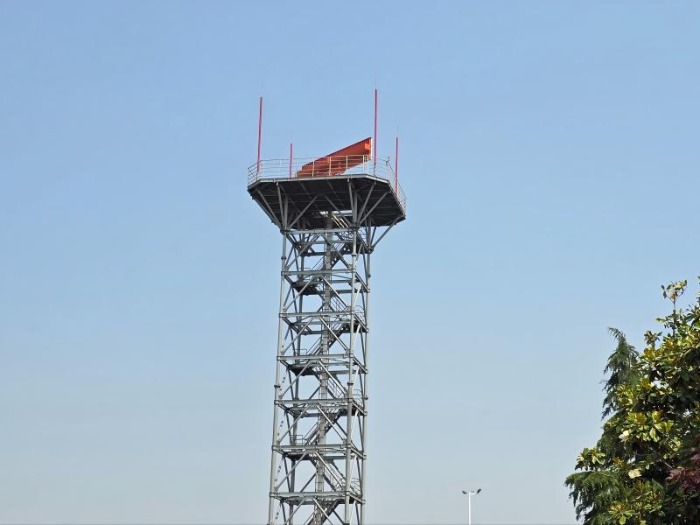
Height ceiling: Monopoles are typically limited to 40–50 meters; lattice towers can exceed 100–300 meters
Load capacity: Lattice towers support heavier equipment loads—critical for multi-operator radar sites and large antenna arrays
Wind performance: Lattice towers exhibit lower deflection under extreme wind loads compared to monopoles
The Core Distinction: Aesthetics vs. Raw Capability
At its simplest, the choice between a monopole and a lattice tower often starts with a fundamental compromise:
| Aspect | Monopole | Lattice Tower |
|---|---|---|
| Appearance | Sleek, low-profile, single tubular pole | Industrial, open framework of steel angles |
| Footprint | Minimal (1–2 m²) | Larger, requires more ground area |
| Primary Strength | Aesthetics, space efficiency, rapid deployment | Raw strength, height capability, heavy loads |
The decision quickly moves beyond aesthetics to a rigorous analysis of costs and capabilities.
Total Cost of Ownership: A Five-Factor Breakdown
1. Material & Fabrication Costs
| Factor | Monopole | Lattice Tower |
|---|---|---|
| Material usage | Higher—requires thick, rolled steel plates | Lower—20–30% less steel for equivalent height/load |
| Fabrication complexity | Complex, capital-intensive (rolling, welding, tapering) | Simpler—angle sections with bolted connections |
| Cost per kilogram | Higher | Lower |
A study comparing fabrication costs found that a steel monopole tower was 79.20% more expensive to fabricate than a lattice tower of equivalent capacity. While lattice towers incur higher on-site labor costs for assembly, the material savings are substantial.
2. Transportation & Logistics
| Factor | Monopole | Lattice Tower |
|---|---|---|
| Shipping profile | Oversized, challenging—requires special permits and escorts | Compact, stackable bundles—maximizes truckload capacity |
| Height limitation | Maximum transportable height is a limiting factor | Components ship in standard lengths |
| Freight cost | Higher | Lower—fewer trips required |
For radar projects in remote locations, the logistics advantage of lattice towers can be decisive. Lattice components can be transported via standard trucks without the oversized-load permits that monopoles often require.
3. Installation & Foundation
| Factor | Monopole | Lattice Tower |
|---|---|---|
| Installation speed | Faster—single or few crane lifts | Slower—requires more on-site bolting labor |
| Foundation size | Larger, more heavily reinforced | Smaller, simpler—distributed load across legs |
| Foundation cost | Higher | Lower—significant savings, especially in poor soil |
The foundation cost differential is particularly important for radar sites in challenging soil conditions. A monopole's concentrated load requires a massive concrete base to resist overturning moments, while a lattice tower's distributed load across multiple legs results in smaller, more cost-effective foundations.
4. Land & Zoning Considerations
| Factor | Monopole | Lattice Tower |
|---|---|---|
| Land requirement | Minimal (1–2 m²) | Larger footprint |
| Zoning approval | Easier—especially in urban or scenic areas | More challenging—industrial appearance can face opposition |
| Camouflage potential | Excellent—can be disguised as trees, flagpoles, or light poles | Limited—open framework is difficult to conceal |
| Visual impact | Low | High |
For radar installations in urban environments, national parks, or aesthetically sensitive areas, the monopole's small footprint and camouflage potential can dramatically speed up zoning approval.
5. Maintenance & Lifetime
| Factor | Monopole | Lattice Tower |
|---|---|---|
| Maintenance frequency | Lower—seamless exterior, fewer debris traps | Higher—latticework traps debris, more surface area to inspect |
| Repair complexity | More difficult—damage to the single shaft can compromise the entire structure | Easier—individual members can be replaced on-site |
| Inspection access | Requires climbing systems or cranes | Platforms and ladder systems provide safer access |
| Corrosion vulnerability | Vulnerable at the base | Prone to corrosion at joints but easier to repair individual sections |
Both tower types, when properly hot-dip galvanized per ASTM A123, deliver 30–50 years of service life. However, the lattice tower's modularity offers a distinct advantage: if a single member is damaged or corroded, it can be replaced on-site without affecting the entire structure.
Structural and Performance Comparison
| Parameter | Monopole | Lattice Tower |
|---|---|---|
| Maximum height | 40–60 meters | 100–300+ meters |
| Load capacity | Moderate (fewer antennas) | High (multiple antennas, heavy equipment) |
| Wind resistance | Acts as solid structure—higher wind load | Open design allows wind to pass through—reduces wind load |
| Deflection under wind | Higher | Lower—lattice towers exhibit better performance under critical wind loads |
| Structural redundancy | Low—single point of failure | High—multiple load paths |
| Strength-to-weight ratio | Moderate | Superior |
For radar applications where antenna alignment precision is critical, the lattice tower's lower deflection under wind loads is a significant advantage. A study found that lattice towers exhibited a maximum tilting of 0.4784 degrees under critical wind loads, compared to 0.5806 degrees for monopoles under the same conditions.
Selection Guide: Matching the Structure to Your Project
| Project Parameter | Recommended Structure | Rationale |
|---|---|---|
| Height < 40m | Monopole | Aesthetic and zoning advantages outweigh cost premium at lower heights |
| Height > 60m | Lattice Tower | Material and foundation savings become substantial; monopole transport/erection becomes prohibitive |
| Heavy radar loads (multiple antennas) | Lattice Tower | Superior load-bearing capacity and stability |
| Constrained urban site | Monopole | Minimal footprint and faster zoning approval are decisive factors |
| Limited budget (CAPEX) | Lattice Tower | Lower upfront costs for materials, fabrication, and foundation |
| Remote or difficult access | Lattice Tower | Easier transport of components via standard trucks; simpler foundations on uneven terrain |
| Rapid deployment | Monopole | Faster installation—critical for emergency or fixed-deadline projects |
| High-wind or coastal site | Lattice Tower | Open design reduces wind load; better dynamic performance |
| Aesthetically sensitive area | Monopole | Easier to camouflage; lower visual impact |
Case Study: Qingdao Altai Tower Radar Support Solutions
Qingdao Altai Tower Co., Ltd. is a professional manufacturer of telecommunication towers, power towers, and tower accessories, established in 2003. The company specializes in the design, manufacturing, and installation of steel towers and communication structures, with products exported to more than 100 countries and regions.
Manufacturing Capabilities
Production capacity: 2,000–3,000 metric tons per month
Equipment: 4000-ton hydraulic CNC bending machine for high-strength, high-precision components
Galvanizing: In-house workshop with Italian equipment, strictly following ASTM A123
Lead time: 30 days after payment
Certifications: ISO9001, ISO14001, ISO45001
Radar Tower Product Line
| Model | Type | Height Range | Key Applications |
|---|---|---|---|
| Weather Radar Lattice Tower | Lattice | 15–50m+ | Weather monitoring, precipitation tracking |
| Airport Weather Radar Mount | Lattice | Custom | Air traffic control, aviation safety |
| Radar Support Lattice Tower | Lattice | Custom | Military, ATC, meteorological operations |
| Monopole Radar Tower | Monopole | 10–40m | Urban radar installations, space-constrained sites |
Quality Standards
Qingdao Altai Tower radar support structures comply with:
ANSI/TIA-222-H/F/G: Structural standards for antenna supporting structures
ASTM A123: Hot-dip galvanizing specifications
AWS D1.1: Welding standards
ISO 1461: Galvanizing standards
FAQ
Q1: Which tower type is more cost-effective for radar applications?
- A: It depends on height and site conditions. For heights under 40 meters in urban areas, monopoles offer faster installation and easier zoning approval, often offsetting their higher material cost. For heights above 60 meters or heavy radar loads, lattice towers are significantly more cost-effective due to lower material costs (20–30% less steel) and simpler foundations.
Q2: What is the maximum height for each tower type?
- A: Monopoles are typically limited to 40–60 meters due to structural constraints. Lattice towers can exceed 100–300 meters, making them the only practical choice for tall radar installations.
Q3: How do wind loads affect each tower type differently?
- A: Monopoles act as solid structures, catching more wind and requiring stronger foundations. Lattice towers have an open design that allows wind to pass through, reducing wind load and enhancing stability in high-wind areas. Lattice towers also exhibit lower deflection under extreme wind conditions.
Q4: Which tower type is easier to transport to remote sites?
- A: Lattice towers are significantly easier to transport. Components ship in compact, stackable bundles and require no special permits. Monopoles often require oversized-load permits, escorts, and specialized trailers, especially for taller structures.
Q5: How does foundation cost compare between the two types?
- A: Monopoles require larger, more heavily reinforced foundations due to concentrated loads. Lattice towers distribute loads across multiple legs, resulting in smaller, simpler, and more cost-effective foundations—a significant saving, particularly in poor soil conditions.
Q6: Which tower type is better for multi-operator radar sites?
- A: Lattice towers are preferred for multi-operator sites due to their higher load capacity and ability to support multiple antennas and heavy equipment. Monopoles have limited load capacity and may not accommodate multiple operators' equipment.
Q7: Can monopoles be camouflaged for aesthetic-sensitive areas?
- A: Yes. Monopoles can be easily disguised as trees, flagpoles, or streetlights, making them ideal for urban, residential, or scenic areas. Lattice towers have an industrial appearance that is difficult to conceal.
Q8: What is the typical service life of each tower type?
- A: Both tower types, when properly hot-dip galvanized per ASTM A123, deliver 30–50 years of service life. Lattice towers offer easier repairability—individual members can be replaced on-site without affecting the entire structure.
Q9: Which tower type installs faster?
- A: Monopoles install faster—typically erected in a single or few crane lifts. Lattice towers require more on-site labor for bolting segments together, extending installation time.
Q10: How do I choose the right tower for my radar project?
- A: Consider these key factors: required height, equipment load, site location (urban vs. rural), budget, zoning requirements, and timeline. Use the selection guide above as a starting point, and consult with an experienced tower engineer for site-specific recommendations.
Conclusion
The choice between a monopole and a lattice tower for radar support structures is not about finding a universally "better" option—it's about identifying the most economically and technically suitable solution for your specific project conditions.
Choose a monopole when visual impact, a small footprint, and rapid deployment are primary drivers, and the project budget can accommodate the associated premium. It is the solution for sensitive and constrained sites.
Choose a lattice tower when maximizing value, achieving extreme heights, or supporting heavy loads are the top priorities. It is the unbeatable workhorse for raw performance and lowest total cost in permissive environments.
By moving beyond a simple initial price tag and conducting a holistic cost-benefit analysis across the structure's entire lifecycle—material, transportation, foundation, installation, and maintenance—project managers can make a confident, data-driven selection that ensures long-term project success and operational reliability.
Ready to choose the optimal radar support structure for your project? Contact Qingdao Altai Tower's engineering team today for a site-specific cost-benefit analysis and custom tower design.
Contact Us


评论
发表评论