Camouflage Tree Towers: Balancing 5G Densification with Urban Aesthetics and Zoning Laws
Introduction: The 5G Density Dilemma
5G’s higher-frequency signals require antenna placement every few hundred meters—far denser than 4G. This density collides with public demand for aesthetic integrity. The solution: camouflage tree towers (monopines, monopalms) that look like anything but towers. These structures blend structural engineering, materials science, and regulatory strategy to enable network expansion where conventional towers would never be permitted.
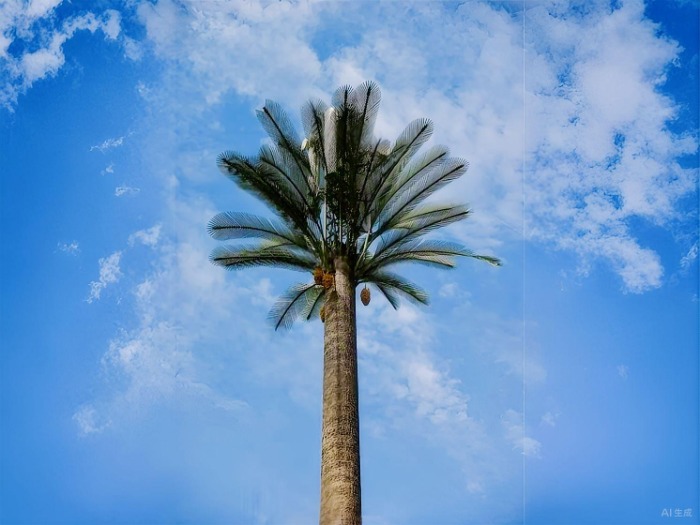
Why Camouflage? The Densification Imperative
5G relies on mid-band (1–6 GHz) and millimeter-wave (24+ GHz) spectrum—short range, easily blocked. Small cells must be mounted 10–30 meters high, appearing in neighborhoods, parks, and along residential streets. Traditional lattice or monopole towers face immediate community opposition. Stealth designs are often the only path to zoning approval.
Technical Design: Core and Disguise
· Structural core: Hot-dip galvanized steel monopole (identical to standard towers), providing all load-bearing capacity.
· Synthetic bark: Fiber-reinforced polymer (FRP) cladding molded from real trees, RF-transparent with <0.5 dB signal loss.
· Branches & foliage: UV-stabilized HDPE, engineered to flex under wind load and resist decades of sun exposure.
· RF-transparent shrouds: Enclose antennas and RRUs without measurable signal attenuation.
Species matching is critical: a pine tower in a pine forest, a palm tower on a beach. Evergreen designs solve seasonal camouflage problems.
Zoning and Regulatory Framework
Telecommunications Act of 1996 prohibits local governments from banning towers outright, but permits aesthetic regulation. Key provisions:
Localities can regulate placement, construction, and modification based on visual impact.
Health-based denial is prohibited if FCC RF exposure limits are met.
Zoning ordinances typically require:
Setbacks (often 125% of tower height)
Height minimums (only as needed for coverage)
Camouflaging architectural treatment in residential or scenic zones
Conditional use permits for stealth designs
Successful projects engage communities early, present species-authentic renderings, and emphasize public safety benefits.
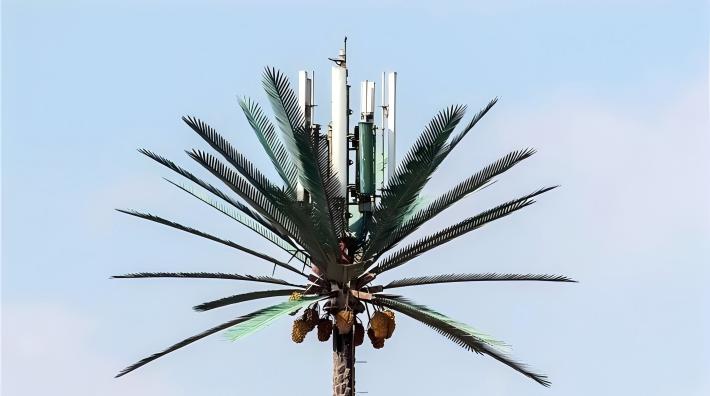
Material and Performance Standards
| Component | Material | RF Performance | Key Standard |
|---|---|---|---|
| Core tower | Galvanized steel | Opaque | ANSI/TIA-222-H |
| Bark cladding | FRP composite | <0.5 dB loss | ASTM G154 (UV) |
| Branches | HDPE with UV stabilizers | Transparent | UV resistance >3,000 hrs |
| Shrouds | RF-transparent fiberglass | <0.5 dB loss | Multi-carrier rated |
All camouflage towers must meet the same structural safety, wind/ice loading, and seismic requirements as conventional monopoles.
Cost-Benefit Analysis
| Factor | Conventional Monopole | Camouflage Tree Tower | Difference |
|---|---|---|---|
| Construction cost | Baseline | +$100k–$150k | 50–100% premium |
| Permit approval time | 18–24 months | 8–12 months | 40–60% faster |
| Zoning opposition | High | Moderate to low | Significant reduction |
| Carrier capacity | 1–2 typical | Up to 5 | Higher revenue potential |
| Service life | 30+ years | 30+ years | Equivalent |
The camouflage premium is an investment in time-to-market and community acceptance, often recouped through earlier revenue and avoided litigation.
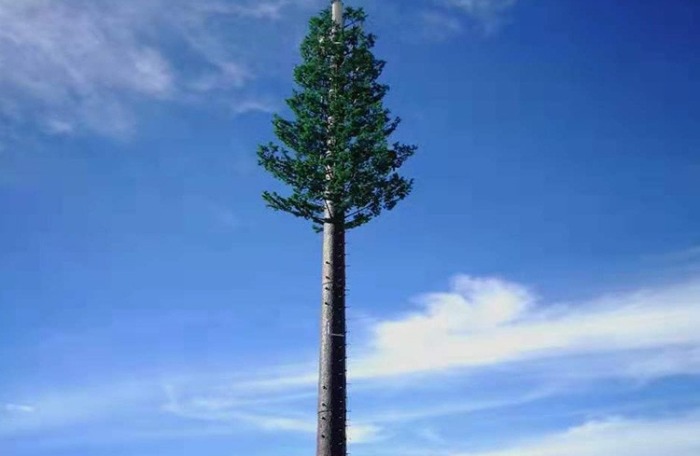
Regulatory Approval Best Practices
Species verification: Match the tower design to dominant native trees.
Visual impact simulation: Provide renderings from all nearby viewpoints.
Seasonal assessment: Evergreen designs avoid winter bareness.
Equipment screening: Hide ground cabinets with faux ivy fencing or underground vaults.
Safety messaging: Emphasize emergency communication benefits, not just data speeds.
Common Pitfalls
Alien species: A cypress tower in a broadleaf woodland (Dartmoor rejection)
Incomplete camouflage: Branches too sparse; tower silhouette visible
Ignoring seasonal change: Deciduous designs become bare poles in winter
Poor community outreach: Surprise applications fuel NIMBY opposition
Conclusion
Camouflage tree towers are not merely aesthetic niceties—they are strategic tools for 5G densification in aesthetic-conscious and environmentally sensitive areas. By investing in authentic species matching, RF-transparent materials, and early community engagement, operators can cut permitting timelines by more than half, reduce legal exposure, and secure sites that conventional towers could never occupy. In the race to deploy 5G, the tower that disappears is the tower that gets built.
Ready to accelerate your 5G rollout in challenging zoning environments? Contact our engineering team for custom camouflage tower design and permit-ready documentation.


评论
发表评论