Palm Tree Towers: Blending Nature with Next-Gen Telecom
For telecom operators battling NIMBY ("Not In My Backyard") resistance in scenic or urban areas, palm tree towers offer a revolutionary solution. These stealth telecommunication structures mimic natural palm trees while housing antennas, microwave links, and IoT systems. Here's a deep dive into their production, technical specs, and performance parameters – engineered for minimal visual impact and maximal functionality.
(1).jpg)
Core Technical Specifications
Modern palm tree towers balance structural integrity, RF efficiency, and aesthetic camouflage.
Key parameters include:
| Parameter | Standard Range | Advanced Models |
|---|---|---|
| Height | 6–20m (20–65 ft) | Up to 25m (82 ft) |
| Trunk Diameter | 0.8–1.2m | 1.5m (with internal ladder) |
| Wind Resistance | 150 km/h (93 mph) | 200 km/h (124 mph) |
| Antenna Capacity | 6–9 sector antennas | 12+ antennas + 4 dishes |
| RF Transparency Loss | <0.7 dB | <0.3 dB (specialized coatings) |
| Camouflage Fidelity | 90% match (50m distance) | 95%+ (species-specific) |
Structural Materials:
Trunk: Galvanized steel core with fiber-reinforced polymer (FRP) bark.
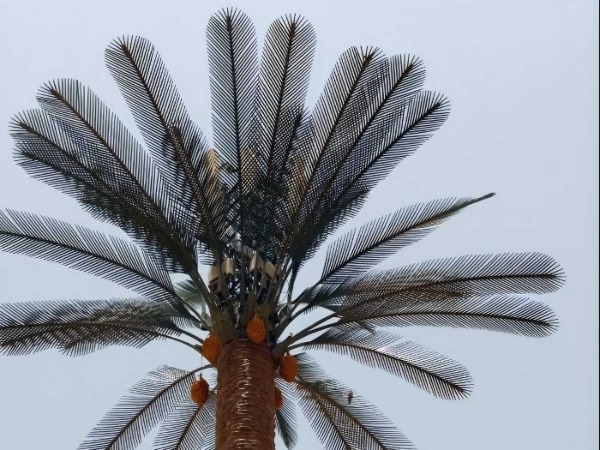
Fronds: UV-resistant polyethylene (PE) or glass-reinforced plastic (GRP) with embedded antenna slots .
Foundation: Reinforced concrete base (4–6m depth, 3–5m diameter) .
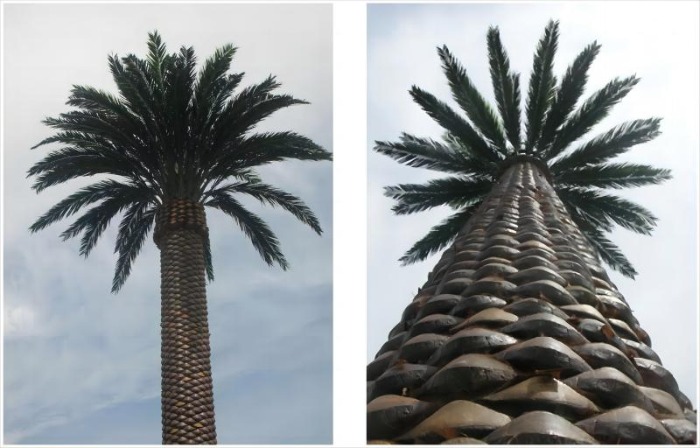
Camouflage Technology: The Science of "Invisibility"
1. Biomimetic Design:
Fronds replicate species like Phoenix dactylifera (date palm) using 3D laser scans of native trees.
Color stability maintained for 10+ years via UV-resistant coatings (ASTM D4329 compliant).
2. RF-Optimized Materials:
FRP trunk cladding with dielectric constant <2.8 ensures minimal signal attenuation.
Concealed ground plane under faux "roots" reduces electromagnetic interference.
3. Environmental Integration:
Bird-safe frond spacing deters nesting.
Infrared-reflective coatings blend with natural canopy in aerial surveys.
Production Workflow: From CAD to Installation
1. Customization & Modeling:
Site-specific scans determine local palm species morphology.
3D BIM software (e.g., Tekla Structures) designs load-bearing lattice and antenna mounts.
2. Fabrication:
Trunk sections: Steel tubes galvanized (150μm zinc coating) for corrosion resistance.
Fronds: Injection-molded PE/GRP with radome slots for antennas.
3. Assembly & Installation:
Modular segments bolted on-site (5–7 days).
Crane-assisted erection + drone-verified antenna alignment.
4. Concealment Tech:
Antennas nested in upper fronds; RRUs hidden in hollow trunk compartments.
Soil/landscaping masks foundation and counterpoise ring.
Deployment Case Study: Dubai's Smart Palms
Location: Surf Beach & waterfront parks.
Specs:
Height: 6m (20 ft).
Frond area: 18m² for solar harvesting.
Services: Free Wi-Fi, device charging, emergency call points.
Results:2.5x faster charging vs. home outlets.
Zero visual complaints in UNESCO heritage zones.
103+ units planned across Dubai.
Critical Constraints & Solutions
| Challenge | Engineering Fix |
|---|---|
| Payload Limits | Hybrid aluminum-steel trunk reinforcements |
| High-Wind Sway | Tuned mass dampers + aerodynamic frond profiling |
| Corrosion (Coastal) | ISO 12944 C5-M marine-grade coatings |
| Maintenance Access | Retractable internal ladder + canopy platforms |
Learn more at www.alttower.com


评论
发表评论